Ap Bio Ch 32 Active Reading Guide
Learning Objectives
In this section, y'all will explore the post-obit questions:
- What is homeostasis?
- What factors affect homeostasis?
- What are differences between negative and positive feedback mechanisms used in homeostasis?
- What are differences betwixt thermoregulation mechanisms in endothermic and ectothermic animals?
Connection for AP® Courses
Animals must exist able to maintain homeostasis—the ability to maintain dynamic equilibrium around a set signal—while also beingness able to respond to changing conditions. For example, equally an endotherm, your trunk temperature remains fairly abiding effectually 37◦C or 98.6◦F. If your temperature climbs to a higher place the set point, you sweat to cool off; if your temperature drops below the set up point, you shiver to warm up. Your blood glucose levels as well remain fairly constant because the liver removes glucose from the blood and converts it to glycogen; when the body cells require glucose, glycogen is broken downward. (You can probably hypothesize how your liver will respond if y'all swallow a dozen jelly donuts!) The failure to maintain homeostasis can be detrimental and tin fifty-fifty cause expiry. Consequently, negative and/or positive feedback loops regulate homeostasis.
Negative feedback mechanisms outcome in slight fluctuations in a higher place and below the set point. For example, if you were to eat a dozen jelly donuts, your blood sugar level would rise, and your pancreas would release insulin, a hormone involved in the conversion of glucose to glycogen, thus returning your blood glucose level to its advisable ready bespeak. Past comparison, positive feedback amplifies responses in the aforementioned direction, with the variable initiating the response moving the arrangement even further away from the gear up point. There are fewer examples of positive feedback, but ane is the onset of labor in childbirth when uterine contractions increment in strength with the secretion of oxytocin, another hormone. Nonetheless, the loss of internal equilibrium due to positive feedback tin exist detrimental; for example, a pocket-sized area of damaged centre tissue can precipitate a eye attack which, in turn, damages even more cardiac muscle.
Information presented and the examples highlighted in the department support concepts outlined in Large Idea two of the AP Biology® Curriculum Framework. The AP® Learning Objectives listed in the Curriculum Framework provide a transparent foundation for the AP® Biology class, an inquiry-based laboratory experience, instructional activities, and AP® exam questions. A learning objective merges required content with one or more of the vii Science Practices.
| Big Idea 2 | Biological systems utilize energy and molecular building blocks to grow, to reproduce, and to maintain dynamic homeostasis. |
| Indelible Agreement 2.C | Organisms use feedback mechanisms to regulate growth and reproduction, and to maintain dynamic homeostasis. |
| Essential Knowledge | 2.C.1 Organisms use feedback mechanisms to maintain their internal environments and reply to external ecology changes. |
| Science Practice | 7.2 The student tin can connect concepts in and beyond domain(s) to generalize or extrapolate in and/or across enduring understandings and/or big ideas. |
| Learning Objective | 2.16 The student is able to connect how organisms utilize negative feedback to maintain their internal environments. |
| Essential Cognition | 2.C.one Organisms employ feedback mechanisms to maintain their internal environments and reply to external environmental changes. |
| Science Practice | v.3 The student can evaluate the evidence provided by data sets in relation to a detail scientific question. |
| Learning Objective | 2.17 The student is able to evaluate data that testify the outcome(s) of changes in concentrations of key molecules on negative feedback mechanisms. |
| Essential Knowledge | ii.C.1 Organisms apply feedback mechanisms to maintain their internal environments and respond to external environmental changes. |
| Science Practice | 6.4 The student can make claims and predictions about natural phenomena based on scientific theories and models. |
| Learning Objective | 2.eighteen The student is able to make predictions most how organisms use negative feedback mechanisms to maintain their international environments. |
| Essential Knowledge | 2.C.1 Organisms utilize feedback mechanisms to maintain their internal environments and reply to external ecology changes. |
| Science Practice | vi.iv The student can make claims and predictions about natural phenomena based on scientific theories and models. |
| Learning Objective | 2.19 The student is able to brand predictions almost how positive feedback mechanisms dilate activities and processes in organisms based on scientific theories and models. |
| Essential Knowledge | 2.C.1 Organisms employ feedback mechanisms to maintain their internal environments and respond to external environmental changes. |
| Science Practice | six.1 The student tin can justify claims with evidence. |
| Learning Objective | 2.twenty The educatee is able to justify that positive feedback mechanisms amplify responses in organisms. |
Animal organs and organ systems constantly suit to internal and external changes through a process called homeostasis ("steady state"). These changes might exist in the level of glucose or calcium in blood or in external temperatures. Homeostasis ways to maintain dynamic equilibrium in the body. It is dynamic because it is constantly adjusting to the changes that the body's systems come across. It is equilibrium considering body functions are kept within specific ranges. Even an fauna that is apparently inactive is maintaining this homeostatic equilibrium.
Homeostatic Process
The goal of homeostasis is the maintenance of equilibrium around a point or value chosen a set signal. While there are normal fluctuations from the set point, the body'due south systems will usually attempt to go back to this betoken. A modify in the internal or external environment is called a stimulus and is detected by a receptor; the response of the system is to adjust the deviation parameter toward the set indicate. For case, if the body becomes too warm, adjustments are made to cool the animal. If the blood's glucose rises subsequently a meal, adjustments are made to lower the claret glucose level past getting the nutrient into tissues that need it or to store it for later use.
Command of Homeostasis
When a change occurs in an brute's environment, an aligning must exist made. The receptor senses the change in the surround, and so sends a indicate to the control center (in most cases, the brain) which in turn generates a response that is signaled to an effector. The effector is a muscle (that contracts or relaxes) or a gland that secretes. Homeostatsis is maintained by negative feedback loops. Positive feedback loops actually button the organism further out of homeostasis, but may be necessary for life to occur. Homeostasis is controlled by the nervous and endocrine system of mammals.
Negative Feedback Mechanisms
Any homeostatic process that changes the direction of the stimulus is a negative feedback loop. It may either increase or subtract the stimulus, merely the stimulus is not allowed to continue as it did before the receptor sensed it. In other words, if a level is too high, the trunk does something to bring information technology down, and conversely, if a level is too low, the body does something to go far get up. Hence the term negative feedback. An example is creature maintenance of blood glucose levels. When an beast has eaten, blood glucose levels rise. This is sensed past the nervous system. Specialized cells in the pancreas sense this, and the hormone insulin is released past the endocrine system. Insulin causes blood glucose levels to decrease, as would be expected in a negative feedback system, as illustrated in Figure 24.21. Yet, if an animal has not eaten and blood glucose levels decrease, this is sensed in another grouping of cells in the pancreas, and the hormone glucagon is released causing glucose levels to increase. This is still a negative feedback loop, but not in the direction expected past the utilise of the term "negative." Another case of an increment as a issue of the feedback loop is the command of claret calcium. If calcium levels decrease, specialized cells in the parathyroid gland sense this and release parathyroid hormone (PTH), causing an increased absorption of calcium through the intestines and kidneys and, possibly, the breakdown of bone in order to liberate calcium. The furnishings of PTH are to heighten blood levels of the element. Negative feedback loops are the predominant machinery used in homeostasis.
Figure 24.21 Claret sugar levels are controlled by a negative feedback loop. (credit: modification of piece of work by Jon Sullivan)
Positive Feedback Loop
A positive feedback loop maintains the direction of the stimulus, maybe accelerating it. Few examples of positive feedback loops exist in animal bodies, just one is found in the cascade of chemic reactions that outcome in blood clotting, or coagulation. As one clotting factor is activated, it activates the next factor in sequence until a fibrin clot is achieved. The management is maintained, not changed, so this is positive feedback. Some other case of positive feedback is uterine contractions during childbirth, equally illustrated in Figure 24.22. The hormone oxytocin, made by the endocrine arrangement, stimulates the contraction of the uterus. This produces pain sensed by the nervous organization. Instead of lowering the oxytocin and causing the pain to subside, more oxytocin is produced until the contractions are powerful enough to produce childbirth.
Visual Connection
Figure 24.22 The birth of a human infant is the result of positive feedback.
State whether each of the following processes is regulated by a positive or negative feedback loop.
a. A person feels satiated after eating a large meal.
b. The blood has plenty of red blood cells. As a result, erythropoietin, a hormone that stimulates the production of new red blood cells, is no longer released from the kidney.
-
a. This is regulated past a positive feedback loop equally the stimulus (hunger) has changed direction in response to a signal (fullness).
b. This is regulated by a positive feedback loop as the stimulus (red blood cell release) has changed direction in response to a betoken (presence of plenty red blood cells).
-
a. This is regulated by a negative feedback loop as the stimulus (hunger) has changed direction in response to a signal (fullness).
b. This is regulated by a positive feedback loop as the management of the stimulus has been maintained.
-
a. This is regulated by a positive feedback loop as the stimulus (hunger) has inverse direction in response to a betoken (fullness).
b. This is regulated by a negative feedback loop as the stimulus (red blood prison cell release) has changed direction in response to a signal (presence of enough red blood cells).
-
a. This is regulated by a negative feedback loop as the stimulus (hunger) changed direction in response to a signal (fullness).
b. This is regulated by a negative feedback loop equally the stimulus (scarlet blood prison cell release) inverse direction in response to a signal (presence of enough red blood cells).
Set Point
It is possible to accommodate a arrangement's prepare bespeak. When this happens, the feedback loop works to maintain the new setting. An example of this is blood pressure: over fourth dimension, the normal or prepare point for blood pressure level can increase as a result of continued increases in blood pressure. The torso no longer recognizes the height as abnormal and no attempt is made to return to the lower ready point. The event is the maintenance of an elevated blood pressure level that can have harmful effects on the body. Medication tin can lower blood pressure and lower the fix point in the system to a more than healthy level. This is called a procedure of amending of the set up betoken in a feedback loop.
Changes tin can be fabricated in a group of body organ systems in club to maintain a set up bespeak in another system. This is called acclimatization. This occurs, for case, when an animal migrates to a higher altitude than it is accustomed to. In order to suit to the lower oxygen levels at the new altitude, the body increases the number of red claret cells circulating in the blood to ensure adequate oxygen delivery to the tissues. Another example of acclimatization is animals that have seasonal changes in their coats: a heavier glaze in the wintertime ensures adequate oestrus retention, and a light coat in summertime assists in keeping body temperature from rising to harmful levels.
Link to Learning
Feedback mechanisms can exist understood in terms of driving a race machine along a track: lookout man a short video lesson on positive and negative feedback loops.
Voltage-gated sodium channels occur in the jail cell membranes of nerve cells. They open up in response to sodium inbound the cell. This allows more sodium to enter the cell.
A scientist claims this is a positive feedback loop. What reasoning can be used to justify this merits?
-
The voltage-gated sodium channels open up in response to sodium influx. When a alter happens in response to a change in weather condition, information technology makes a positive feedback loop.
-
The voltage-gated sodium channels close when there is enough sodium in the cell. This self regulation means this is an example of a positive feedback loop.
-
The voltage-gated sodium channels open due to sodium and this causes more sodium to go through. The response reinforces the feedback, making this a positive feedback loop.
-
The voltage-gated sodium channels are on the cell membrane. All channels through cell membranes are examples of positive feedback loops. This, this is an examples of a positive feedback loop.
Science Practice Connectedness for AP® Courses
Retrieve About It
How are negative feedback loops used to regulate body homeostasis? How is a status such as diabetes a good case of the failure of a set bespeak in humans? Hypothesize and draw a diagram that shows what you call up is the feedback failure for a person with diabetes.
Teacher Support
Negative feedback loops maintain the levels of some variable about a set indicate. In diabetes, a ascent in blood glucose does not signal the production of insulin, which would commonly lower claret glucose dorsum to the set point. The Think Nearly It question is an application of AP® Learning Objective 2.16 and Scientific discipline Practise 7.2 and Learning Objective 2.17 and Science Exercise v.iii because students are connecting negative feedback to the regulation of homeostasis and then, using claret saccharide levels in humans equally an example, explaining how a change in a negative feedback machinery can have a deleterious outcome.
Homeostasis: Thermoregulation
Trunk temperature affects body activities. More often than not, equally body temperature rises, enzyme activeness rises as well. For every ten degree centigrade rise in temperature, enzyme activeness doubles, upwards to a point. Torso proteins, including enzymes, brainstorm to denature and lose their role with high heat (effectually loC for mammals). Enzyme action will decrease by half for every ten degree centigrade drib in temperature, to the point of freezing, with a few exceptions. Some fish tin withstand freezing solid and return to normal with thawing.
Link to Learning
Watch this Discovery Channel video on thermoregulation to see illustrations of this process in a variety of animals.
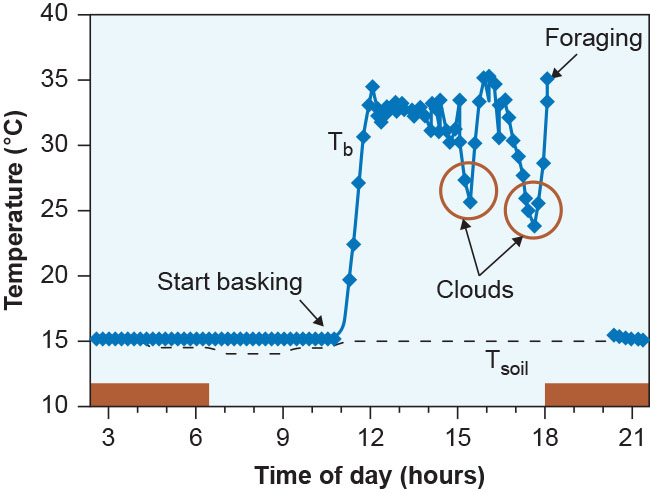 (credit: modification of work by Terrien, J. et al./Frontiers in Bioscience)
 Effigy 24.23
This graph shows the body temperature of an animal in various hours of the day.
What can be said well-nigh this creature?
-
The animal keeps its body temperature relatively constant.
-
The animal is most active during the morning hours.
-
The animate being is more agile when it's torso temperature is above xxx °C.
-
The fauna is active at night.
Endotherms and Ectotherms
Animals can be divided into two groups: some maintain a abiding torso temperature in the face of differing environmental temperatures, while others take a body temperature that is the same as their environment and thus varies with the environment. Animals that rely on external temperatures to set their body temperature are ectotherms. This grouping has been called common cold-blooded, but the term may not apply to an animal in the desert with a very warm body temperature. In contrast to ectotherms, poikilotherms are animals with constantly varying internal temperatures. An fauna that maintains a constant trunk temperature in the confront of environmental changes is called a homeotherm. Endotherms are animals that rely on internal sources for maintenance of relatively constant body temperature in varying environmental temperatures. These animals are able to maintain a level of metabolic activity at cooler temperature, which an ectotherm cannot due to differing enzyme levels of activity. Information technology is worth mentioning that some ectotherms and poikilotherms take relatively abiding body temperatures due to the abiding environmental temperatures in their habitats. These animals are so-called ectothermic homeotherms, like some deep ocean fish species.
Effigy 24.24 Heat can exist exchanged by iv mechanisms: (a) radiations, (b) evaporation, (c) convection, or (d) conduction. (credit b: modification of work by "Kullez"/Flickr; credit c: modification of work by Chad Rosenthal; credit d: modification of work by "stacey.d"/Flickr)
Everyday Connection for AP® Courses
Figure 24.25 The body temperature of ectotherms varies with the environment. For that reason, reptiles, such as this American alligator, bask in the sun to warm themselves.
If an American alligator has been basking just gets besides hot, how might the alligator cool itself?
-
increment vasodilation
-
sweat
-
move into shade
-
increment metabolic rate
Oestrus Conservation and Dissipation
Animals conserve or dissipate heat in a variety of ways. In certain climates, endothermic animals take some form of insulation, such as fur, fatty, feathers, or some combination thereof. Animals with thick fur or feathers create an insulating layer of air between their pare and internal organs. Polar bears and seals alive and swim in a subfreezing environment and yet maintain a abiding, warm, body temperature. The arctic fox, for example, uses its fluffy tail as extra insulation when information technology curls upwards to sleep in common cold conditions. Mammals accept a residual effect from shivering and increased muscle activity: arrector pili muscles cause "goose bumps," causing small hairs to stand up when the individual is cold; this has the intended issue of increasing body temperature. Mammals employ layers of fat to attain the same end. Loss of significant amounts of body fat will compromise an individual'south power to conserve heat.
Endotherms use their circulatory systems to help maintain body temperature. Vasodilation brings more blood and heat to the body surface, facilitating radiations and evaporative estrus loss, which helps to absurd the trunk. Vasoconstriction reduces blood flow in peripheral blood vessels, forcing claret toward the core and the vital organs found there, and conserving rut. Some animals take adaptations to their circulatory system that enable them to transfer heat from arteries to veins, warming blood returning to the heart. This is called a countercurrent estrus substitution; information technology prevents the common cold venous blood from cooling the heart and other internal organs. This accommodation tin can be shut down in some animals to prevent overheating the internal organs. The countercurrent adaptation is found in many animals, including dolphins, sharks, bony fish, bees, and hummingbirds. In dissimilarity, similar adaptations can help cool endotherms when needed, such as dolphin flukes and elephant ears.
Some ectothermic animals utilise changes in their beliefs to help regulate trunk temperature. For example, a desert ectothermic creature may just seek cooler areas during the hottest role of the day in the desert to continue from getting also warm. The same animals may climb onto rocks to capture heat during a cold desert night. Some animals seek water to aid evaporation in cooling them, as seen with reptiles. Other ectotherms use group activity such as the activeness of bees to warm a hive to survive winter.
Many animals, specially mammals, employ metabolic waste matter heat as a heat source. When muscles are contracted, most of the energy from the ATP used in muscle actions is wasted free energy that translates into heat. Severe cold elicits a shivering reflex that generates rut for the trunk. Many species also take a type of adipose tissue called brown fat that specializes in generating rut.
Neural Command of Thermoregulation
The nervous system is important to thermoregulation, as illustrated in Effigy 24.24. The processes of homeostasis and temperature command are centered in the hypothalamus of the advanced brute encephalon.
Visual Connection
Figure 24.26 The trunk is able to regulate temperature in response to signals from the nervous system.
When bacteria are destroyed by leukocytes, pyrogens are released into the blood. Pyrogens reset the body's thermostat to a college temperature, resulting in fever. How practice pyrogens cause trunk temperature to rise?
-
Pyrogens broadcast to the hypothalamus to reset the torso's "thermostat," causing a rise in temperature.
-
Pyrogens broadcast to the thalamus to reset the torso'south "thermostat," causing a rise in temperature.
-
Pyrogens cause an increase in the action of the animate being's enzymes, which results in the temperature rise.
-
Pyrogens entering the blood release some lipid substances, which ultimately cause the rise in temperature.
The hypothalamus maintains the set point for trunk temperature through reflexes that cause vasodilation and sweating when the body is besides warm, or vasoconstriction and shivering when the trunk is also cold. It responds to chemicals from the torso. When a bacterium is destroyed by phagocytic leukocytes, chemicals called endogenous pyrogens are released into the claret. These pyrogens circulate to the hypothalamus and reset the thermostat. This allows the body's temperature to increase in what is commonly called a fever. An increase in trunk temperature causes iron to be conserved, which reduces a nutrient needed past leaner. An increase in body heat also increases the activity of the beast'south enzymes and protective cells while inhibiting the enzymes and activity of the invading microorganisms. Finally, heat itself may also kill the pathogen. A fever that was once idea to be a complication of an infection is now understood to be a normal defense mechanism.
Source: https://openstax.org/books/biology-ap-courses/pages/24-3-homeostasis
0 Response to "Ap Bio Ch 32 Active Reading Guide"
Post a Comment